SKU: 84893171743
thorny succulents

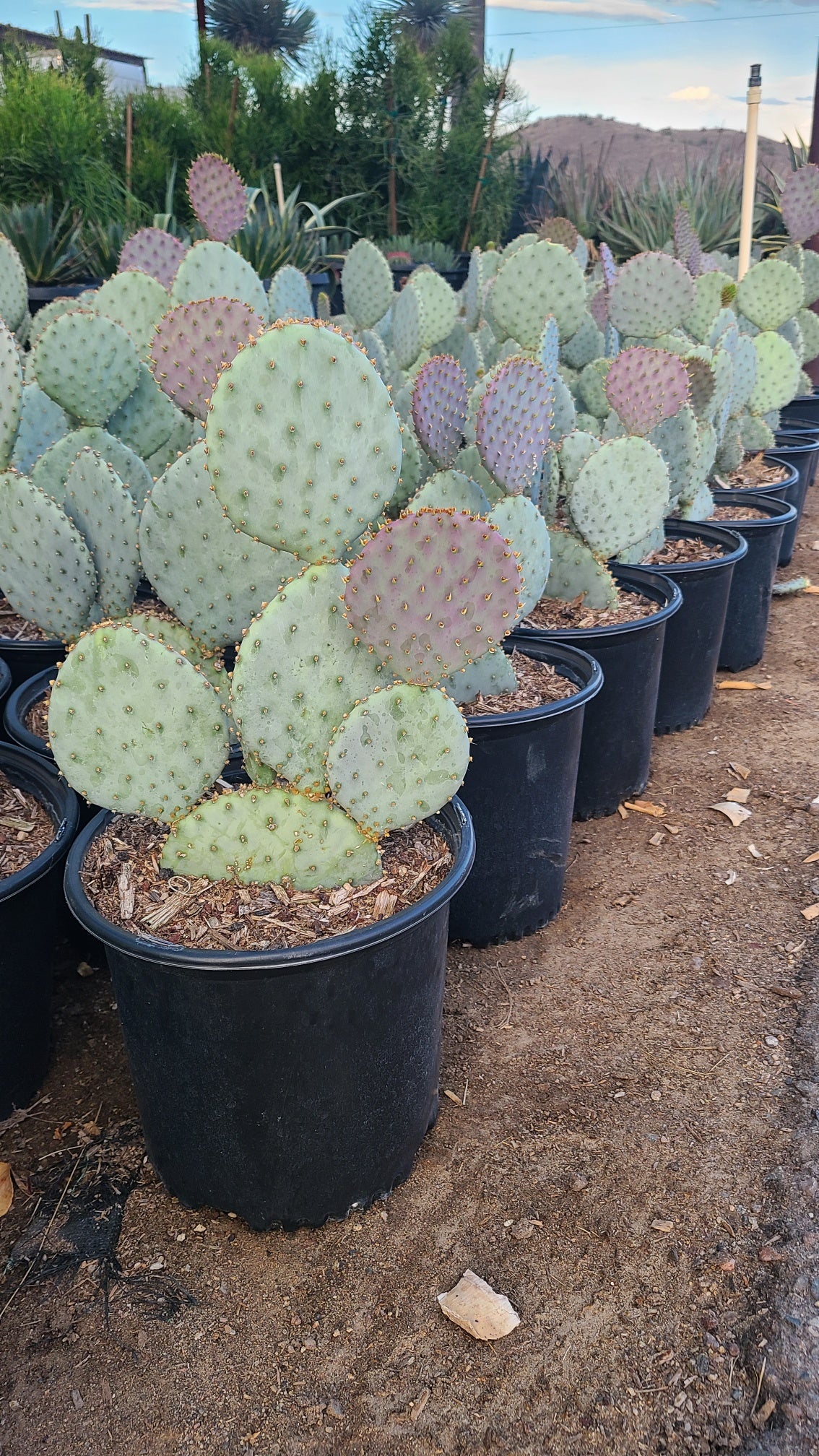
thorny succulents Buy Purple Prickly Pear Phoenix, AZ | Opuntia santa-rita

Sale price$23.02 Regular price$25.58
Save 10%

Pay in installments of $6.39 with ShopPay, AfterPay and Klarna

Shipping Estimate
USA
  • USA
  • CAN

Ships within 48 hours · Estimated delivery Sep 3 - Sep 8

Promo Codes Available:

For Your Every Summer RSVP, with Code: SUMMER15

Description

thorny succulents Buy Purple Prickly Pear Phoenix, AZ | Opuntia santa-ritaArizona's Most Colorful Native Cactus Purple Pads Year Round The Purple Prickly Pear (Opuntia santa rita) is the showstopper of the prickly pear family and one of the most eye catching native cacti you can plant in a Phoenix landscape. Its broad, flat pads shift from blue green to deep purple under cold or drought stress meaning you get stunning color exactly when your garden needs it most. Growing just 23 feet tall and spreading 35 feet wide, this

Arizona's Most Colorful Native Cactus — Purple Pads Year-Round

The Purple Prickly Pear (Opuntia santa-rita) is the showstopper of the prickly pear family and one of the most eye-catching native cacti you can plant in a Phoenix landscape. Its broad, flat pads shift from blue-green to deep purple under cold or drought stress — meaning you get stunning color exactly when your garden needs it most. Growing just 2–3 feet tall and spreading 3–5 feet wide, this low-growing cactus produces showy yellow flowers with red-orange centers in spring, followed by edible reddish-purple fruit. Whether you're building a drought-tolerant front yard in Scottsdale, filling a rocky slope in Fountain Hills, or creating a native cactus garden in Mesa — Purple Prickly Pear delivers year-round color with zero irrigation once established.

Purple Prickly Pear Plant Details

Attribute Detail
Scientific Name Opuntia santa-rita
Common Names Purple Prickly Pear, Santa Rita Prickly Pear, Violet Prickly Pear
Mature Height 2–3 feet
Mature Width 3–5 feet (spreading)
Growth Rate Moderate — fills in within 1–2 years in Phoenix
Sun Full sun (6+ hrs). Handles reflected heat from walls and pavement.
Water Extremely low once established. Thrives on rainfall alone in Phoenix.
USDA Zones 8–11 (Phoenix is Zone 9b–10a)
Soil Well-draining. Adapts to Arizona caliche and rocky native soils.
Foliage Evergreen — pads stay year-round, turn purple in cold/drought
Native Status Native to Arizona, southern New Mexico, and northern Mexico

Purple Prickly Pear Uses in Phoenix Landscapes

Drought-Tolerant Front Yard & Xeriscape

Purple Prickly Pear is the ultimate zero-water landscape plant once established. Mass-plant 3–5 specimens across a gravel or decomposed granite bed for a colorful, maintenance-free front yard. The purple pads pop against warm-toned gravel — a look that's become a signature of modern Scottsdale and Gilbert xeriscapes. Pair with Golden Barrel Cactus and Desert Spoon for texture contrast.

Native Cactus Garden

Create an authentic Sonoran Desert garden by grouping Purple Prickly Pear with Engleman's Prickly Pear, Mexican Fence Post, and Totem Pole cactus. The color contrast between the purple pads and the green columnar cacti creates a striking display. This combination thrives in Tempe, Chandler, and Mesa with almost no supplemental water.

Slope & Erosion Control

The spreading growth habit and dense root system make Purple Prickly Pear an excellent choice for stabilizing slopes and hillsides in Fountain Hills, Cave Creek, and north Scottsdale. Plant 3 feet apart on slopes — the pads will knit together within 2 seasons to create a colorful, erosion-resistant groundcover.

Wildlife & Pollinator Garden

The spring flowers attract native bees and butterflies, while the edible fruit feeds birds and desert wildlife through summer. Plant near a patio or window in Peoria or Glendale for front-row wildlife viewing.

Best Time to Plant Purple Prickly Pear in Phoenix

Fall (October–November) is ideal — warm soil encourages root growth while cooler air reduces transplant stress. This gives your prickly pear 6–8 months of root establishment before its first Phoenix summer. Spring (February–April) is the second-best window. Avoid planting in peak summer if possible, though established Purple Prickly Pear is incredibly heat-tolerant.

How to Plant Purple Prickly Pear

  1. Dig wide, not deep — 2–3x the root ball width, same depth as the container.
  2. Check for caliche — break through any hardpan layer for drainage. Prickly pear will rot in standing water.
  3. Backfill with native soil — no amendments needed. This cactus prefers lean, rocky soil.
  4. Spacing — 3 feet apart for mass planting or slope coverage; 4–5 feet for individual specimens.
  5. Water basin — build a shallow ring to direct water to roots during establishment only.
  6. Mulch — 2–3 inches of gravel or decomposed granite. Never use organic mulch against cacti.

Watering Purple Prickly Pear in Phoenix

First Year Watering Schedule

Weeks 1–2: Every 3–4 days, deep and slow. Month 1–2: Every 7–10 days. Month 3–6: Every 2 weeks. After Year 1: Rainfall only in most Phoenix locations. Supplement once monthly in peak summer only if pads look shriveled.

Drip Irrigation

Place one 1 GPH emitter 12 inches from the base during the first year. After establishment, remove or turn off supplemental irrigation — overwatering is the #1 killer of prickly pear in Phoenix landscapes.

How fast does Purple Prickly Pear grow in Phoenix?
Moderate growth — a 1-gallon plant will fill a 3–4 foot area within 2 years in full sun. New pads emerge in spring and summer, each one adding to the spreading clump.

Why do the pads turn purple?
The purple coloring intensifies during cold weather (winter) and drought stress. It's caused by anthocyanin pigments — the same compounds that make blueberries blue. The more stress, the deeper the purple. In summer with regular water, pads shift back toward blue-green.

Is Purple Prickly Pear fruit edible?
Yes! The reddish-purple fruit (called tunas) is edible and has been used in traditional Southwestern cuisine for centuries. Harvest with tongs in late summer — they make excellent jams, syrups, and agua fresca.

Does Purple Prickly Pear have spines?
Purple Prickly Pear has fewer spines than most prickly pear species, but it does have glochids (tiny hair-like barbs). Plant it at least 3 feet from walkways and play areas. Use leather gloves when handling.

Can Purple Prickly Pear handle Phoenix summer heat?
Absolutely — it's native to the Sonoran Desert and handles temperatures well above 115°F. It also tolerates reflected heat from walls, concrete, and asphalt without any issues.

You May Also Like

Engleman's Prickly Pear — Arizona's classic green prickly pear, perfect for pairing with Purple Prickly Pear for a two-tone cactus display.
Golden Barrel Cactus — A round, golden-spined cactus that contrasts beautifully with the flat purple pads.
Mexican Fence Post — A tall columnar cactus that adds vertical height behind low-growing prickly pear.
Queen Victoria Agave — A compact, geometric agave with white markings — stunning accent next to purple pads.
Totem Pole Major — A smooth, spineless columnar cactus that pairs perfectly in modern desert gardens.

How Many Purple Prickly Pear Do I Need?

This is a low, spreading cactus (3 to 5 ft wide) that knits together for slope cover, mass plantings, and erosion control. Space plants about 3 ft on center to fill in within two seasons. Use the coverage table to plan a bed or slope:

Area to Cover Plants at 3 ft Centers
50 sq ft 5–6
100 sq ft 11–12
200 sq ft 22–24

For a single color accent in a gravel bed, one plant reads beautifully. Keep all plantings at least 3 ft back from walkways and play areas, since the pads carry glochids.

Purple Prickly Pear Season-by-Season in Phoenix

  • Spring (Feb–Apr): Showy yellow flowers with red-orange centers open along the pad edges, drawing native bees and butterflies. New pads flush as the weather warms. Strong second planting window.
  • Summer (May–Sep): Shrugs off temperatures well above 115°F and reflected heat on rainfall alone. Edible reddish-purple tunas ripen by late summer. Keep soil dry between any supplemental soaks.
  • Fall (Oct–Nov): Prime planting season. Warm soil and mild air give roots months to establish.
  • Winter (Dec–Jan): Cold and drought stress deepen the pads to vivid purple, the plant's signature look. Very cold hardy to about 15°F, so it sails through Valley winters with no protection.

At a Glance

✔ Arizona Native   ✔ Heat-Loving (Reflected-Heat Tolerant)   ✔ Drought-Tolerant   ✔ Pollinator-Friendly   ✔ Edible   ✔ Evergreen   ✔ Low-Maintenance   ✔ Fire-Wise   ✔ Deer & Rabbit-Resistant   ✔ Cold-Hardy to 15°F

Plant It With

  • Engleman's Prickly Pear: Arizona's green native prickly pear for a two-tone pad display.
  • Mexican Fence Post: tall columns that add vertical height behind the low purple pads.
  • Totem Pole Major: a smooth sculptural column that pairs cleanly in a modern desert bed.
  • Desert Spoon: a silvery rosette that adds soft texture contrast to the flat pads.

Is Purple Prickly Pear Right for Your Yard?

It thrives in full sun and reflected heat in lean, fast-draining native soil, making it a no-irrigation choice for front yards, slopes, and native cactus gardens. Break through caliche so water never stands at the roots. It is not a fit right beside walkways, patios, or play areas, since the glochids catch skin and clothing: give it at least 3 ft of clearance.

Shipping Notes
  • Free Standard Shipping on $100+ Orders to the USA.
  • Except Preorder products are shipped in 48 hours.
  • Delivery to the USA:
  1. Standard Shipping : 3-10 business days
  • If time is of the essence, please consider selecting expedited delivery for faster service.
Exchange/Return Notes
  • We offer a 30-day return/exchange service after receiving.
  • Final sale items are not eligible for returns or exchanges.
  • To process your return/exchange, please contact us at [email protected]
  • Please click here for more details>>> Return & Exchange Policy
SKU: 84893171743

Discover Niche Categories That Outsell thorny succulents

Top-Converting Item to Boost Your Average Order

4.1 ★★★★★
Based on 25 reviews
Sort
Highest Rating
Newest First
Oldest First
Product Reviews
L
LG
Dallas, US
★★★★★ 4
Nicely made and easy to read
Format: Hardcover
This arrived well packaged, but despite this, the two top corners of the book were somewhat smashed and there was more significant damage at the bottom of the spine where it was smashed. There is also some damage on the spine itself at about the level where Crossway is printed. The book appears well made and the paper is a good quality and thick. The print is of a nice size. One will most likely never access all the information enclosed in this commentary. In addition, one will most likely not agree with everything written, which should be expected of all commentaries. Commentaries are simply that and not authoritative. One hopes that by reading they might learn something new or be prompted to look more closely at a subject or issue. Let's look at Leviticus 11, for example, where the dietary guidelines are given to the Israelites. In the comments regarding pigs being forbidden, it is noted that the Philistines raised pigs for food. Knowing that, one can come to a conclusion that this may be why they were forbidden, so as to make a difference, or distinction, between the two peoples and not necessarily that pigs were bad to eat. In addition, throughout the commentary the reader is taken not just to other Old Testament passages, but where applicable the New Testament is referenced. Again using Leviticus 11, at the end of the chapter the commentary brings up the Jerusalem Council in Acts 15 when they issued the four requirements for Gentiles. It is noted that, "The Jerusalem Council agreed on four nonnegotiables to bring Jewish and Gentile believers to the same table, drawn in large measure from Leviticus's laws on holy living for the resident alien."
WAS THIS REVIEW HELPFUL?YesReportShare
Reviewed in the United States on July 18, 2025
D
Dave V.
Lexington, US
★★★★★ 5
The Final Volume of An Excellent Commentary Series Does Not Disappoint
Format: Hardcover
After 7 years, Crossway has completed their ESV Expository Commentary set. Ironically, Vol. 1, was the last of the twelve volumes to be completed. It fully lives up to the standard the other eleven set. Like the other volumes, it focuses on a passage by passage commentary of each book, followed by a ‘Response’ section that is usually some form of practical application of belief or behavior. For example, in my copy, the ribbon marker was already in Exodus 17:1-7’s ‘Response’ page, and it discussed the question of ‘Why Does God Test His People?’. Jay Sklar’s response includes this wisdom: ‘testing not only gives us an opportunity to show faithfulness; it also helps us to to become more faithful.’ (pg. 578). While I have not yet read the whole thing, Crossway seems to have balanced some well-known scholars with other lesser known ones. Genesis in this volume is covered by Iain Duguid, noted OT scholar currently teaching at Westminster Seminary. Exodus is examined by Covenant Seminary Professor of Old Testament, Jay Sklar, who is a well-known expert on all five books of the Pentateuch. I had not heard of Christine Palmer (Leviticus) or Ronald Bergey (Numbers) before, but Crossway has earned my trust, and I presume their contributions will live up to the standards of others in this series. The commentary is pretty beefy, and the hardcover binding (if my previous volumes are any indication) will need to be handled with care - especially if you are like me, and sometimes try to photocopy pages so you don’t have to carry the whole commentary to a coffee shop or library! All in all, if you are a pastor, Bible student, or lead a Bible study, this series, and this volume, will be a benefit to you.
WAS THIS REVIEW HELPFUL?YesReportShare
Reviewed in the United States on June 20, 2025
L
Lori A Alsdorf
Fort Morgan, US
★★★★★ 5
Excellent, Readable Bible Commentary
Format: Hardcover, Format: Hardcover
I feel more than a little inadequate writing a review of this first volume of the Expository Commentary which uses the English Standard Version (ESV) of the Holy Bible. The ESV has become my favorite Bible translation due to its excellent readability and reliability, thus influencing my decision to order this commentary. Just as readability influences my choice of Bible translations, this commentary also does an excellent job of maintaining readability across all four authors, each one having authored one complete book- Genesis through Numbers. This is a scholarly work and as such it uses references to a large body of additional scholarly works, more than three full pages worth, and lists abbreviations for each with those abbreviations noted throughout the text of the commentary for each book in the volume. These references include ancient as well as more contemporary works, most have English titles and a number are works grounded in the original Hebrew. Another help for any expositor are the ongoing references to other Bible passages that relate to the text of the commentary. Each of these references, and there are thousands of them, are listed in a Scripture Index organized from Genesis to Revelation that require nearly sixty pages at the very back of the volume. Though I’ve not read all 1392 pages, I’ve found editing to be excellent, though I did find one error on page 34 that had no consequence for understanding the meaning. I know many prefer the ease of using digital resources for study due to quick access, portability, and easy storage (I found this resource is also available digitally). I can easily recommend this resource without reservation.
WAS THIS REVIEW HELPFUL?YesReportShare
Reviewed in the United States on July 5, 2025
J
Verified Purchase
JustinHoca
San Leandro, US
★★★★★ 5
Helpful and informative
Format: Kindle
Four Views on the Book of Revelation (Counterpoints: Bible and Theology) edited by Stanley N. Gundry and C. Marvin Pate I read this book after previously reviewing Revelation in Context: John’s Apocalypse and Second Temple Judaism. That book was helpful for me to understand Revelation as apocalyptic literature, one example of the genre with similarities to others from the first and second centuries. Interpreting Revelation as apocalyptic literature is itself a choice, and some approaches to Revelation, such as classic dispensationalism with its emphasis on grammatical-historical hermeneutics are skeptical of that approach. As Thomas writes in his chapter “To understand any passage of Scripture in a nonliteral way violates principles of grammatical-historical interpretation unless contextual features signal a need to interpret otherwise” (p. 244). I found Revelation in Context helpful for introducing various apocalyptic books of the age in providing greater context for Jewish thought up to and after John wrote Revelation. The editors of Four Views provide a good overview of the four views presented as well as a good introduction to Revelation. The four authors and their positions are: Kenneth L. Gentry, Jr. (preterist) Sam Hamstra, Jr. (idealist) C. Marvin Pate (progressive dispensationalist) Robert L. Thomas (classical dispensationalist) Each author made a case for his position and responded briefly to points by the other authors. Thomas is the most insistent in his argument and spends the most time critiquing the others’ positions. The differences stem entirely from their hermeneutics, each has a different approach to the book and each calls “foul” with the others’ misuse or lack of consistency of their own hermeneutics. For me, the winner was the preterist position, as I’d never truly been exposed to this paradigm. The author allows it to speak for itself, and I found it appealing because of how well the events of 68-70 AD as described (mainly) by Josephus line up eerily well with the words of Revelation. In some cases, it seems Josephus is quoting Revelation, which made me wonder whether the authors had taken liberties with the actual translation of Josephus’ works. After reading Gentry Jr.’s view, reading Revelation with a preterist’s viewpoint in mind made it a completely different book for me. Whether the position is correct or not, it allowed me to read Revelation again for the first time, so to speak– that was a gift. Thomas drove home for me that classical dispensationalism demands a special place for the ethnic people of Israel including a rebuilding of the temple along with its sacrifices. Babylon on the Euphrates is literally the Babylon of old and must also be rebuilt, which he interprets to be a Persian/Iranian empire that will come to fruition again. I think I can see how this view is at long last falling out of favor. Some of the writers may be somewhat heterodox. Gentry, for example, leaves open some possibilities for partial preterism or has some reasoning other preterists don’t have. Thomas is appalled at progressive dispensationalism’s “now and not yet” mentality as violating rules of grammatical-historical interpretation. Pate leaves the door open to Revelation having an earlier authorship and more sections being fulfilled in the first century than Thomas allows. Hamstra is in a field of his own, the “idealist” position sees Revelation as purely symbolic and not specific to any time period– everyone undergoing persecution is experiencing the spirit of the Antichrist, etc. Since reading this book, I’ve been checking out podcasts on preterism while pondering how covenantalists I know seem to sound like progressive dispensationalists. I am glad this book was published and will check out similar works in this series. Five stars.
WAS THIS REVIEW HELPFUL?YesReportShare
Reviewed in the United States on May 6, 2026
A
Verified Purchase
Andrew A. Carr
Massapequa, US
★★★★★ 5
A Little Gem
Format: Paperback
This little book is a wonderful resource for teachers, pastors, and all who want to gain a better understanding of the book of Revelation. The introduction by Marvin Pate is a real gem. It gives a helpful (and sometimes humorous) overview of the various positions expounded in the remainder of the book, and it offers a valuable apology for the study of prophecy. He points out that neither fanaticism nor the neglect of biblical prophecy is a healthy option for the follower of Christ. The heart of this volume is the presentation of four common interpretations of the book of Revelation. Kenneth Gentry does a nice job of presenting the preterist position, which is normally linked to postmillennialism. This position found a resurgence in the late 1980’s and 90’s after being on the brink of extinction. Gentry gives a good deal of historical information from Josephus’s Jewish War to bolster his interpretation of Revelation, yet questions remain. Do the atrocities of which Josephus writes reach the global proportions mentioned in Revelation? In addition, do the many passages quoted in support of a glorious earthly kingdom really affirm a postmillennial kingdom? Finally, the preterist position articulated by Gentry necessitates a pre 70 AD date for the composition of Revelation. While this is not impossible, it is improbable, as most NT scholars hold to a post 70 date. The idealist view is ably defended by Sam Hamstra. The idealist view is often associated with amillennialism and has a long history stretching back to Augustine. It sees Revelation as a representation of the ongoing battle between good and evil. It denies a chronological and literal reading of revelation. The real value of this position is that it excels in bringing out the timeless theological truths which are embedded in Revelation. These truths can provide hope and encouragement for saints of any time or place. However, it does seem questionable whether Revelation was intended to be read in a nonchronological manner. The other difficulty is that it tends to strip Revelation of historical specificity. By saying that the prophecies of Revelation can apply to any age in general, one comes close to saying that they apply to no age in particular. The final view is that of premillennialism, which is represented by both a classical dispensationalist and a progressive dispensationalist. The two views have much in common as they both read Revelation more literally than the other two positions, and both see chronological progression in the book of Revelation. Robert Thomas defends the classical dispensationalist approach by stressing a literal hermeneutic and a chronological reading of Revelation. Marvin Pate represents progressive dispensationalism which synthesizes many of the positive features of the other three views while still maintaining a distinction between Israel and the church. One of the key elements of progressive dispensationalism is the emphasis on “pattern prophecy”. This understanding of prophecy allows for the repetition of prophetic events throughout history with escalating levels of fulfillment. Classical dispensationalist writers include John Walvoord, Dwight Pentecost, and Charles Ryrie. Progressive dispensationalism is represented by Darrell Bock and Craig Blaising. While dispensationalism is grounded in biblical soil, some would question whether it does justice to the highly symbolic and figurative language of biblical prophecy, and whether those prophecies should be seen as referring to actual future events that will occur in a chronological progression. This book is especially helpful when comparing eschatological systems and how they influence the interpretation of the book of Revelation. If one is looking to study the book of Revelation, this is a great place to start.
WAS THIS REVIEW HELPFUL?YesReportShare
Reviewed in the United States on November 3, 2013

recommand products